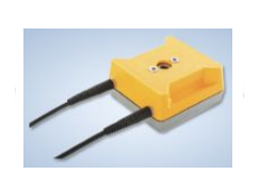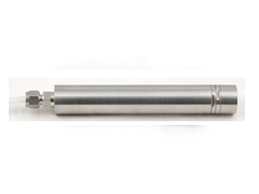


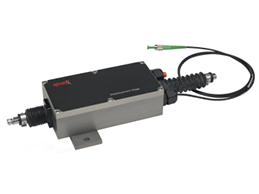
Fiber Bragg grating sensors, which reflected wavelengths shifts in response to temperature changes
Operate very similarly to the temperature sensors, the wavelength responds to the applied strain
Displacement sensors measure structural deformation estimation using the strain data
FBG sensor technology relies on some sophisticated technology and physics. Laser light travels through a fiber core in a very defined manner. A Bragg grating is introduced onto the core of a fiber and the many reflections off of this grating create a stable sensor. Any strain (temperature, pressure, vibration, etc.), applied to the fiber Bragg grating into the fiber will cause a wavelength shift and magnitude change of the reflections. This change allows for very accurate measurements to be performed either over a long period of time or in an ultra-fast event.
Fiber Bragg grating sensors use an FBG as a sensing element. FBG is highly responsive not only to mechanical deformation but also to temperature changes.
When the light beam travels towards the fiber Bragg grating, but the only specific wavelength of light is reflected by the refractive index, this wavelength is called Bragg wavelength. Essentially, this is what causes fiber optic Bragg grating to transmit most of the light while reflecting only certain wavelength.
The sensor may be located far away from the interrogating device (tens of kilometers), which applies to the quasi-distributed system based on FBG, as well as to any distributed systems, however, they have a very fast reply and low heat retention. It doesn’t require a power supply, grounding, and galvanic isolation, and it functions perfectly well under adverse climatic conditions and aggressive environment.
Fiber optic system has complete fire and explosion safety, it can’t hit with the electrical shock, and it doesn’t emit radio waves.
Fiber Bragg Grating (FBG) temperature sensors operate by identifying shifts in the Bragg wavelength as temperatures change. Both the refractive index and the spacing of the grating undergo minor adjustments, resulting in a detectable alteration in the reflected light wavelength. This shift can be accurately correlated to temperature changes, allowing for accurate temperature measurements.
Fiber Bragg Grating (FBG) temperature sensors find broad application across numerous industries. They are valued for their resilience in challenging conditions where standard sensors may be ineffective. Some primary uses include:
Fiber Bragg Grating (FBG) temperature sensors provide a durable, precise, and energy-efficient approach to temperature detection, utilizing optical fiber technology to deliver high performance.
Fiber Bragg Grating (FBG) strain sensors measure strain by detecting shifts in light wavelengths within a customized optical fiber. They operate through the interaction of light with an optical fiber, where the reflected wavelength varies in response to the applied strain.
Fiber Bragg Grating (FBG) strain sensors are widespread in a variety of fields:
Fiber Bragg Grating (FBG) strain sensors are an advanced technology for monitoring structural strain. Their high sensitivity, capability for multipoint measurements, and durability make them a crucial solution for improving safety and dependability in mechanical systems.
Fiber Bragg Grating (FBG) pressure sensors use the spectral analysis of reflected wavelengths to monitor various parameters. The fundamental principle is that external forces affecting the sensor alter the Bragg wavelength, allowing indirect measurements of changes in FBG’s structures or properties. These sensors are effective for measuring relative pressure and tracking liquid and gas levels in tanks and pipelines.
Fiber Bragg Grating (FBG) pressure sensors are used in structural monitoring, biomedical applications, industrial processes, telecommunications, and more.
Fiber Bragg Grating (FBG) pressure sensors are integral in multiple industries, showcasing their adaptability across diverse fields.
Fiber Bragg Grating (FBG) accelerometers are precision sensing instruments that leverage fiber optics and Bragg grating technology to measure acceleration. These sensors function by detecting shifts in the Bragg wavelength which occurs because of strain and temperature variations.
Fiber Bragg Grating (FBG) accelerometers are indispensable across a range of industries:
Fiber Bragg Grating (FBG) accelerometers represent a cutting-edge solution for acceleration measurements, offering high sensitivity, resistance to EMI, and versatility across various applications.
Fiber Bragg Grating (FBG) displacement sensors estimate structural deformations by analysing strain data. They leverage unique attributes of Fiber Bragg Gratings to achieve high sensitivity and resistance to external interference.
Fiber Bragg Grating (FBG) displacement sensors serve diverse objectives across multiple sectors including:
Fiber Bragg Grating (FBG) displacement sensors represent a significant advancement in measurement technology, providing high precision, reliability, and flexibility, particularly, in challenging environments. Their capability to measure a variety of structural parameters makes them invaluable across numerous fields.