

Skip to content

FBG Displacement Sensors

Fiber Bragg grating displacement sensors are modern sensing devices that are often used in structural health monitoring (SHM) systems. These sensors are extremely precise and impervious to electromagnetic interference, and corrosion. FBG displacement sensors operate in a different manner compared to strain and temperature sensors, they use the FBG response to its equivalent Bragg wavelength to measure quantity. Displacement sensors make the estimation of the structural deformation based on the collected strain data. Fiber Bragg grating displacement sensors are surface-mounted and detect the distance between two anchor points. If combined with other elements these sensors are capable of calculating the soil displacement. On top of that, they can track extension and compression displacement.

Specifications Overview

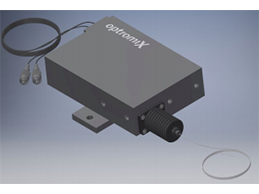
Fiber bragg grating (FBG) Displacement Sensor D1

D1

This sensor is designed to measure displacements, cracks, and expansion joints over a 12 mm range. The sensor has a protective aluminum case. It can be mounted directly on concrete or metal surfaces.
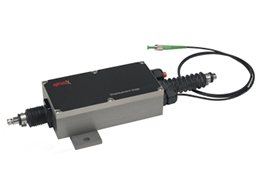
Fiber bragg grating (FBG) Displacement Sensor D2

D2

This sensor is designed to measure displacements,
cracks, and expansion joints over 50 mm range.
The sensor has a protective aluminum case. It can
be mounted directly on concrete or metal surfaces.

Key Features

Fiber Bragg grating displacement sensors possess several unique features that make them applicable in various environments.

Precision and sensitivity

FBG displacement sensors extraordinary sensitivity enables precise detection of the smallest displacements. The precise measurement of any variations in the Bragg wavelength is essential to detect any structural problems.

Immunity to electromagnetic interference

Regular electronic sensors may not function properly under certain conditions, whereas FBG displacement sensors provide reliable data due to their immunity to EMI. This feature makes them exceptionally useful in areas with high radio & other EMI.

Multiplexing capability

FBG displacement sensors may be either mounted on the surface or embedded into smart systems. They are easy to install and minimize cable costs compared to traditional sensing systems.

Integration capability

FBG displacement sensors can be effortlessly integrated with other sensing technologies. For example, strain and temperature sensors can improve data quality and provide a comprehensive image of the monitored structure.

Wide range of applications

FBG displacement sensors are suitable for measuring soil movements, monitoring cracks, assessing structural integrity, and more. Thus, they are useful in many industries, including energy, civil and geotechnical engineering.

Applications

One of the most common uses for FBG displacement sensors is structural health monitoring (SHM). These sensors play an important role in assessing and managing structural integrity over time. They give the exact data required to ensure infrastructure safety and lifespan.

Bridges

Bridges experience traffic loads, temperature fluctuation, and natural forces, which impact their structure in time. FBG sensors are employed for continuous tracking of various critical parameters allowing for proper maintenance to reduce any risks and extend bridge service life.

Tall buildings

FBG displacement sensors may be embedded into structural elements during the construction, thus ensuring an ongoing process of tracking any deformation caused by wind or seismic activity.

Dams

There are many potential risks that are associated with large dam failures. Hence, the process of evaluating structural integrity is paramount. FBG displacement sensors provide invaluable data about the health and performance of the dam, as well as allow it to implement an alert system to detect any potential issues early on.

FBG displacement sensors provide consistent and exact data, which are critical for the safety and maintenance of a wide range of engineering structures.